Biography
Alan Turing
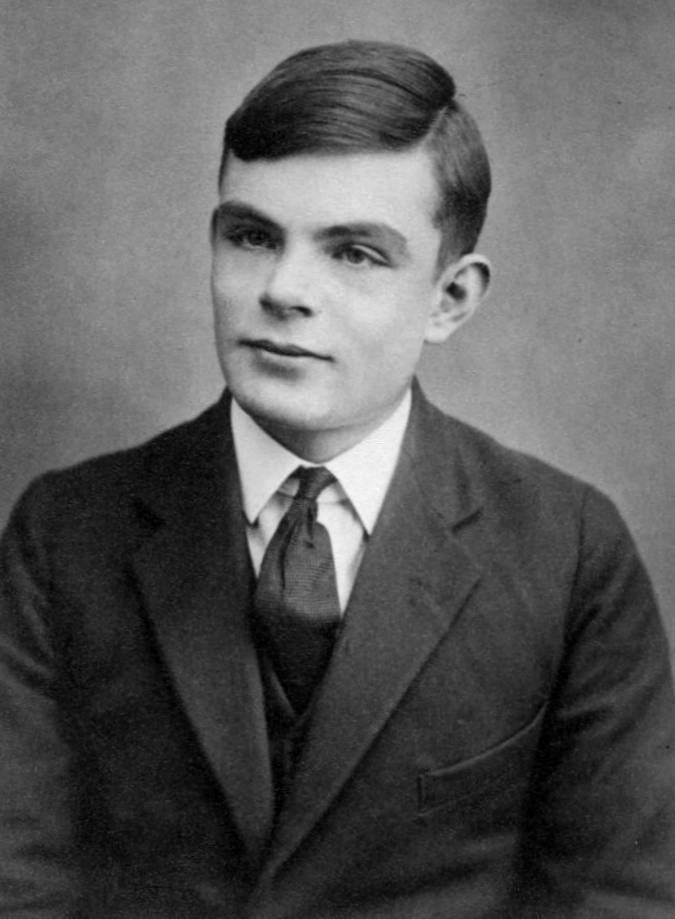
- Born
- 23 June 1912
- Died
- 7 June 1954
- Nationality
- British
- Known for
- The Turing machine, The Turing test, Codebreaking at Bletchley Park
Alan Turing gave computer science its foundations before there were any computers to build on. In 1936, while still in his twenties, he published a paper that asked what it means for something to be computable and answered it with an imaginary device now called the Turing machine. The argument showed that a single machine, given the right instructions, could carry out any computation at all. That is the idea of the general-purpose computer, stated in mathematics a decade before the hardware existed.
During the Second World War he put theory to use at Bletchley Park, where his work on breaking German ciphers, including the Enigma system, is credited with shortening the war and saving many lives. After it he helped design early stored-program computers and turned to the question of whether machines could think, proposing in 1950 the test that still carries his name.
Turing’s life ended early and unjustly. Prosecuted for his homosexuality, then a crime in Britain, he died in 1954. He received a formal pardon decades later. His ideas, by then, were everywhere in the field he had founded.
Frequently asked
What did Alan Turing invent?
In 1936 he described the Turing machine, a simple abstract device that captures what it means to compute. It proved that a single machine could carry out any computation, which is the theoretical basis of the general-purpose computer.
What is the Turing test?
It is a test Turing proposed in 1950 for machine intelligence. If a person cannot reliably tell whether they are talking to a human or a machine through written conversation, the machine passes. It shaped how people think about artificial intelligence.
Why is Alan Turing important?
He gave computer science its theoretical foundation, helped break German ciphers during the Second World War, and set the early agenda for artificial intelligence. Much modern computing traces back to his ideas.